
On Struggle (Part 2): Embracing the Evolving Mind

Thought Processes of the Mind and Spaces in Between

At the core of productive struggle is a practice in which the mind accommodates new experiences and ideas by first allowing room for the questioning, and if necessary, loss of pre-existing notions. This practice is simply represented in the following elementary math students experience:

Kriya learns about squares one day in math class – an intangible four-sided enclosed shape, with congruent sides that come together to form four right angles. All class, students tackle square-related problems. Then, the teacher presents a challenge problem in which there is a diamond-shaped figure. Kriya’s peers observe the drawing…they all begin to assert how it must be a “weird square” but a square nevertheless. Kriya begins to wonder, “Is a square the only four sided enclosed shape in the world?” She looks around the classroom – the ceiling didn’t have four congruent sides and the textbook on her desk was not quite like squares either. “Then, perhaps, not all four sided shapes in the world are square,” Kriya wonders.

What was it about Kriya’s mental habits that allowed her to engage and grow as a math student? Unlike her classmates, who began to classify all four-sided figures as squares, Kriya questioned the belief that “everything presented to the class will be some sort of square.” She left room in her mind for the possibility of the loss of beliefs and the arrival of new notions and learning. This space for letting go and accepting the loss of thought processes when old ideas fail to provide a clear view of reality is the cornerstone of productive struggle.

Let’s fast forward 7 years – Kriya is now in 12th grade and, with her flexible mind and habits, she has thus far experienced success in high school mathematics. She is now taking College Calculus. One day, the teacher presents a graph and asks the students to work together to find one method that accurately approximates the area under the curve between two bounds. Kriya talks to classmates – initially befuddled, they put their heads together to come up with some idea. For the first time, Kriya feels like she just can’t do math, “Perhaps, I’m actually not cut out for this? Maybe real math is too hard for me. I can’t even come up with a simple method.” Dismayed, Kriya doubts her abilities…as the teacher comes by to give hints to the group she is still lost in thought and misses the guidance.

While Kriya had practice in leaving room for new content in her mind, she now faced a very different aspect of the practice: leaving room for new insights that impact one’s psychology. Kriya had trouble fitting two ideas, failure and mathematical success, in her mind. There was no space or flexibility for the two notions to co-exist. However, to make room for the notion that failure is part of learning math, Kriya needs to modify the second belief. Instead of just believing “I am successful in mathematics”, she can more accurately accommodate the belief, “Success in mathematics entails failure, frustration, and perseverance.” This belief leaves room for failing, trying again, failing, and trying again…building immense capacity for perseverance.

What have these examples shown us? In order to learn, we must practice letting go of and accepting the loss of beliefs that no longer align with reality or lead to growth. This practice is not confined to learning content (subject-specific material). It encompasses our psychology and we must choose between being static or embracing the evolving mind. The mind evolves with loss and renewal, allowing all of us to engage in productive struggles. As I wrote in On Struggle (Part 1): Befriending Struggle, struggle is our toughest teacher – it helps us question our beliefs so we can evolve into more resilient individuals ready to absorb and assimilate knowledge about the world around us and within us. In my next post “On Struggle (Part 3),” I will post a meditation on Embracing the Evolving Mind.

Posted in Anxiety & Struggle, Grit, Metacognition, Self-Regulation | Tagged , , , , , , | 2 Comments

On Struggle (Part I): Befriending Struggle

Struggle. This one word often invokes frustration, annoyance, and hopelessness among students. But why? I always ask my students: What’s so bad about struggle? Tell me about it! What’s the big deal?  In fact, I just asked these questions to one of my classes last week. My students often laugh back at me when I ask this (and yes, they laughed last week too :D). I think we all know the answer. My question is neither sarcastic nor rhetorical. It is an earnest attempt at possibly finding answers on why the human mind doesn’t like struggle.

Brilliant Rainbow Breaks Through Grey Clouds of Struggle

One reason is that it is energy-consuming (as opposed to energy-conserving, a principle of survival). In other words, struggle requires change. The brain undergoes physical changes as the brain cells (neurons) rewire. The emotional parts of the mind need refueling as the mind deals with the patterns of joys and frustrations. Habits of  perseverance need to be sustained with action: practice, thinking, practice, thinking, practice.

So, how do we deal with this unpleasant energy-consuming reality of learning? If we choose to be self-caring individuals, we face struggle – but not as a stranger. We do this by befriending Struggle. We give Struggle the status of our truest friend – one that asks questions until we find answers, the one that stumps us until we prove that we understand, the one that argues until we justify, and the one that cries until we present a means that resonates with it. This is Struggle. Struggle, when dealt with in a healthy manor, is the bitter truth that will help us evolve and change as humans. In any endeavor, Struggle never leaves your side because she knows that, without her, we will most likely remain iert, careless, and blase. Struggle is our toughest and best teacher – in searching for answers, it is struggle who leads us to asking our classroom teachers, coaches, parents, and mentors the most essential questions to breaking open daunting concepts and skills. So, let’s embrace Struggle – let’s give her the status of an unwavering and most truthful friend. Let’s thank Struggle for helping us change through learning. Let’s rejoice for a newly made friendship with Struggle!

Action for this post:

List the pros of struggle and give struggle a life, as I did in the article (above). It may be useful to look at all the struggles you have had, and list what you learned from them. Sometime, we view struggle through a negative or warped perspective and it seems that we did not grow or learn – but if we look closely, we can continue to learn from struggle – even today! The more human “Struggle” becomes, the more likely you are to befriend her! 

Posted in Anxiety & Struggle, Metacognition, Preparing the Mind | Tagged , , , , , , , | 2 Comments

Judging, Labeling, & Mathematics: An Unfortunately Common Practice

Every year, I come across students that say one of the following phrases in the beginning of the year and I work hard all year to change the beliefs behind such statements:

  • “I used to be good at math but these problems make me feel like I’m bad at math.”
  • “I’ve never been good at math and never will be.”
  • “I’m just not a math person.”
  • “I’m good at math – I like it”
  • “I am a math person”
  • “Oh no…this is not going to be fun.” (as soon as we begin a new topic).

At the surface level, these comments show that students believe that they are either good or bad at mathematics. Finding a substantial middle ground is rare. Underlying the labels of oneself as fitting into either a “good at math” or “bad at math” category is the unhealthy belief that one’s mind is fixed (I recommend reading Carol Dweck’s work on fixed vs. growth mindset). Rather than having the ability to learn and grow and change, the mind is somehow incapable of stretching and expanding to build pattern-recognition skills, develop creativity, and hone visuo-spatial abilities. What an insult to both ourselves and the the powers of our minds!

Hand in hand with these self-limiting beliefs comes the tendency of our minds to constantly judge our actions and their results, further pushing us into categories (slow/fast, dull/creative, failing/promising, etc):

  • If I see a classmate moving ahead on practice problems, then I must be slow.
  • If I answer a question in correctly in class, then I probably looked and/or sounded dumb.
  • If my teacher challenges me to think deeper, then he/she must be out to get me. (Teachers push students beyond what they think they could do in order to promote growth, not to test them.)
  • I got a bad grade. Therefore, I must be bad at math.
  • I have gotten bad grades in math for the last 3 years, so I’m probably not cut out for math.
  • I am good at math but now it feels challenging – so I must be bad at math.
  • I got all the problems right on my last homework, so now I am good at math.

All of these thoughts lead to more judgemental thoughts and before you know it, you have become an expert on judging yourself (often, quite negatively)! While we could list many reasons for why we, as a society, have a tendency to label our mathematical abilities, I choose to move myself and my students beyond the “why”s and into action. We learn to “un-condition” a mind that is so used to thinking in a black and white manner about mathematical abilities.

But how? One of the answers lies in a simple yet profound meditation on non-judgement. At the core of meditation is the idea that the mind is capable of profound growth and change through active effort. In the “Non-Judgement Meditation” (which will be posted in the next article!), we specifically train our minds to break links between subsequent thoughts AND replace judgemental thoughts with non-judgemental thoughts. For example, instead of reacting to being slower than a classmate as an indicator of being incapable at math, the mind stops all analysis after recognizing the characteristics of the situation as follows:

  1. My classmate finished the 3 problems we were assigned.
  2. I am working on these 3 problems.
  3. Instead of giving time for the mind to wander, you direct your mind to work on the task in present moment.
  4. If labels or judgement arise, let them pass by as unimportant thoughts.

Let’s look at another example:

A challenging math problem is put on the board. Instead of thinking “I can’t get this”, “this is going to be too hard”, or “I never get challenges”, we train the mind to think:

  1. Challenge problem.
  2. You read the problem.
  3. That’s it! And now, the mind is actively directed to the task of tinkering, finding patterns, and collaborating on the task in the present moment.

Now, does this mean that one should never judge a situation to see how things are going? Definitely not! However, space for non judgement needs to be made if judgemental thoughts have taken center stage – especially in places like the mathematics classroom where labels and judgements are unfortunately plentiful.

Action for this post:

For the next few days, notice the judgments your mind forms during the day.

  • What labels do you apply to yourself?
  • How do these thoughts help or harm your progress and growth as a student (this counts for adults too because we are learning everyday in our classroom, the real world!).
  • How do you react to mistakes?
  • How often do you label yourself as good/bad for not getting everything right the first time around?
  • How do you perceive your abilities in different situations?

NOTE: I will be posting the “Non-Judgement Meditation” very soon, so stay tuned to practice after reflecting! The meditation will be most effective if you are familiar with the judgements that arise in your mind!


Posted in Anxiety, Math Anxiety, Metacognition, Non-Judgement, Preparing the Mind | Tagged , , , , | 2 Comments

Test Anxiety Meditation II: Decluttering the Mind and Heart

NOTE: Those of us who are not students can use this by substituting test anxiety with extreme nervousness during high pressure situations (public talks, meetings with a boss, high-pressure deadlines at work, etc.)


In high pressure situations, such as exams or performances, our minds have a tendency to try looking into the future. What if this doesn’t go well? What if I fail? What if the results make me look bad? What if…

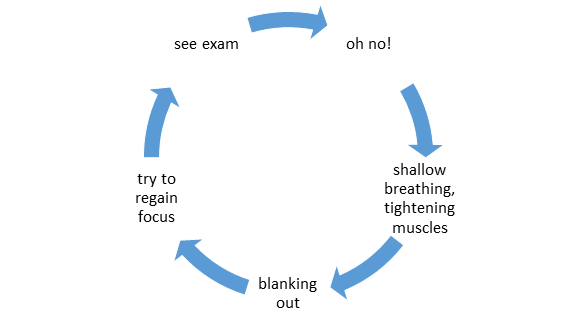
All these “what if” scenarios about results are a preoccupation with the future in disguise. They distract us from the task at hand and transport us into an unknown future. If we let our thoughts and feelings of worry and distress build up in our minds, they will inevitably manifest in our bodies in the form of tights jaws, faster heartbeats, dry mouth, etc. Recall the cycle we sketched in “A New School Year…An Old Habit”, below, showing what happens in the middle of an exam or exam-like scenarios when the panic response turns on.


Exam Anxiety Cycle

Our insides fill up so quickly as the initial future-oriented thoughts snowball into a full blown preoccupation with the possibility of failure so that there is no space left in the mind for thoughts that are needed right now. The mind becomes so cluttered that our bodies also feel suffocated and vice-versa. We blank out. We can’t think logically. We lose our capacity to recall basic facts.

So, how can we prevent, or at least slow down, this snowballing process to save and free up some space in our minds? We do this be creating a route for the fearful thoughts and feelings to leave our mind and body right through and out of the heart!

Try this brief meditation technique “Decluttering the Mind and Heart”:

  1. Close your eyes. As you breathe in, acknowledge all of your future-oriented thoughts and related feelings hindering your ability to think. Examples of thoughts include: “I’m not going to be able to do this. Last time I did horribly, what if I fail this time?” Examples of feelings include feelings of desperation, feeling like giving up, etc. On the exhale, imagine all of these bottled up thoughts and feelings drop down into your chest. A thousand birds are waiting to pick them up. As soon as you exhale and the thoughts and feelings drop down into your hIMG_2220 (1)eart, a thousand birds pick them up and fly away, flapping their strong wings. The birds fly right out of your chest and into the world and travel so far that you cannot even see them anymore. Your worries, frustration, and self-deprecating thoughts leave along with the birds, creating space in your mind for the present moment.
  2. If the bird imagery does not work effectively for you, bring your hands together in front of you, as if you are creating a bowl for water using your palms. Imagine your thoughts and feelings flow into your hands. On the next exhalation, the thoughts and feelings leave your hands and disappear into the air.

In creating a route for overwhelming and anxious thoughts and feelings out of your mind and body, you create more space for the thoughts that you need in the moment. If you are taking a test, you may be able to think about the questions in front of you with greater ease now. If you are racing in a track meet, you may be able to more easily access your coach’s advice. If you are giving a speech, this will create space for you to retrieve information.

Posted in Anxiety & Struggle, Math Anxiety, Self-Regulation, Test Anxiety | Tagged , , , , , , | Leave a comment

Exam Anxiety Meditation I

NOTE: Those of us who are not students can use this by substituting test anxiety with extreme nervousness during high pressure situations (public talks, meetings with a boss, high-pressure deadlines at work, etc.)


I had promised that I would post a series of reflective meditations for A New School Year…An Old Habit: Test Anxiety, and this post introduces the first of a series of exercises. The following picture was used to describe what happens to some of us when we get nervous during exams.

Exam Anxiety Cycle

The aim of the first meditation is to address the link: “shallow breathing, tightening muscles”. If we weaken this link, then the following links grow weaker. This allows us to regain some composure. To use this exercise effectively during times of need, we must diligently practice using the meditation.

Action for this post:

Practice “Exam Anxiety Meditation I” (below) everyday for the next week or so and try using it just before or during an exam or other high-pressure situation!


Posted in Anxiety, Anxiety & Struggle, Math Anxiety, Preparing the Mind, Test Anxiety | Tagged , , , , , | 2 Comments

A New School Year…An Old Habit: Test Anxiety

NOTE: Those of us who are not students can read this article by substituting test anxiety with extreme nervousness during high pressure situations (public talks, meetings with a boss, high-pressure deadlines at work, etc.)

As summer begins to point towards Fall and we catch glimpses of subsiding summer heat, it is time to prepare ourselves for the unknowns of a new school year – new teachers, new courses, new classmates, so much “new”ness! Among so many unknowns, there are some old pieces we carry with us – positive and negative memories, friendships, and knowledge from the previous school year. We also bring our old habits with us – healthy and unhealthy.

One habit that many of my students bring back to the classroom every year is anxiety around exams, tests, and quizzes. The notion of a timed test throws many students into a frenzy. As a result, the new school year sometimes loses its charm not because of tests, but because of how we handle tests at an emotional level. To some of us, exams are unforgiving monsters, ready to gobble up all of our confidence. Others view exams as unnecessary and unending suffering… only to end in June and begin again in September. Many students get to the point of saying, “I just hear the word exam or test and get very nervous – I just can’t do it – I get so overwhelmed and I feel horrible about myself.”

Well, here’s the good news: test anxiety is not an insurmountable problem. With time, patience, hard work, and practice, the unhealthy levels of nervousness felt during exam time does begin to subside. A consistently anxious reaction towards exams is an old habit. The presence of an exam followed by an immediate reaction further implies some underlying habit that has become deeply ingrained in your brain over time. An example of how the brain may travel under pressure is as follows –

see exam –> oh no! → shallow breathing,tightening muscles→ blanking out →  try  regaining focus → see exam →…

And it all starts again.  It becomes very difficult to retrieve and logically analyze information.  The old habit is also a cyclic pattern, and it grows stronger over time if not resolved at any one piece. We could more easily understand the chain of events like this:

In order to break the cycle, we could try to distract ourselves from the nervous thoughts. The problem with this is that we are already distracted from the exam by a deeply ingrained habit. The thoughts and feelings that arise as a response to an exam pop up right away because the habit has become almost automatic. The one piece we could definitely loosen is the “shallow breathing, tightening muscles.” Once we loosen that piece, all the pieces afterwards also grow weaker and weaker over time!! It could look more like this (larger letters implying greater strength):

see exam → oh no! → shallow breathing,

tightening muscles→ blanking out →  try to regaining focus → see exam –> oh no! → shallow breathing

tightening muscles→ blanking out →  try  regaining focus → see exam →oh no! → shallow breathing, 
tightening muscles→ blanking out →  try  regaining focus → see exam…

As you can see, the magnitude of the response diminishes as soon as one of the pieces loses strength.

Action for this post:

I am down with a cold and will be recording meditation again in a few days. Instead of one meditation, I will be posting a series of short meditations to counter test anxiety over the course of the next two weeks rather than today. Stay tuned!

Posted in Preparing the Mind, Test Anxiety | Tagged , | 3 Comments

Unplugging for Clarity

When we don’t give ourselves the opportunity to unplug (literally, from all the electronic devices we use), and sit down with ourselves, acknowledge our exhaustion, our joys and failures of the day, our feelings of defeat, and our feelings of triumph, we lose the opportunity to reconnect with ourselves. Our minds lose focus and, with this loss, we find it difficult to build meaning and purpose in our lives.

There’s an emptiness that sometimes fills the soul when we lie down and just watch TV or surf the web day in and day out during our free time. During that time, we pull ourselves away from what truly exists right now in our immediate environment and, instead, get pulled into a screen that makes us feel like we are traveling, meeting people, and learning about the world. Now, there’s nothing that says there is anything wrong with occasional leisurely indulgences and escapes from reality. However, almost anyone who has experienced some sort of live retreat – a temporary shift of focus away from everyday activity – will say that turning off all digital devices left them with a feeling of deep relaxation, as if having let go of some of life’s burdens. The tweets, Instagram pictures, and facebook newsfeed posts that make people feel incomplete at times are turned off. And now, with this new space created inside, we can engage in the present moment. This helps reset our focus and refresh our minds.

The action for this article comes in the form of a retreat of your choice:

With the next school year just around the corner (and for those of us out of school, with the next season just around the corner), perhaps it is time to take a mini-retreat of our choice. For a series of 3 consecutive days, do not use your phone, laptop, iPad, TV (etc..) during IMG_0129 (2)your free time. This means that, once you are finished with work that requires the internet, you do not take even a few more minutes to browse the web or check your phone for text messages.

What happens when you leave your devices behind?  Listen to what your body and mind say and do in the moment! Maybe you can write a letter to a good friend or bake in the kitchen without the luxury of looking up recipes on the internet. You could take a quiet walk or lay down in your bed to re-reading a childhood book. You might feel like checking your phone or turning on the news, but you can also let these feelings pass like waves of the mind. If a 3-day retreat is challenging, try one day at a time!

Posted in Focus & Clarity, Metacognition, Preparing the Mind, Stillness | Tagged , , , , , , , , | 1 Comment

Waves of the Mind

IMG_0437Growing up, my parents told me a lot of stories from ancient Indian epics. There was one piece that always stuck in my mind. It was a repeated phrase which roughly  translates, “In a moment of fury (or any other emotion), he/she lost all knowledge.” As a child I always wondered what this meant – I don’t know why I never asked! As I began exploring the mind-body connection, observed myself, and my students, I realized that the phrase captured a brilliant idea. Fury is an intense emotion. And when the character was full of this intense emotion, he or she was unable to access rational thought. Everything he or she knew was true seemed to disappear into thin air. In the midst of fury or any other emotion the strong and highly intelligent character would act in regrettable or inexplicable ways.

Have you ever experienced this loss of of balance in moments of nervousness, anger, or excitement?  In my classrooms and in classrooms and schools around the world, students (and  educators) experience the consequences of intense emotions. Consider the following:

  1. A student is so nervous during a test that she blanks out and forgets everything. The well-learned material only comes back to her later. But it was always there. There was just a temporary block of access.
  2. A student is trying to follow a math problem at the board and begins to think, “everyone around understands a problem except for me.” Feeling embarrassed and frustrated, he is no longer able to focus and follow the teacher.
  3. Under time pressure (see Harnessing the Breath), a student feels overwhelmed and  all the material the student studied leading up to an exam seems to mysteriously disappear.
  4. During a speech, which ad been practiced many many times, the speaker looks at the big crowd and gets so anxious that she forgets the next line.

This list could go on…

To prevent ourselves from being pulled into the waves of emotions when we need to retrieve information, focus on a task, or control our reactions, we must also practice watching our emotions and thoughts as if we are outside of our body and mind. In Indian philosophy, this is called sakshi-bhava and, in Buddhist philosophy, it is called vipassana (mindfulness meditation). We are impartial observers of our minds – we watch our own thoughts, emotions, and sensations. In practicing how to be a witness of our own internal world, we begin to also learn how to handle emotions that throw us off in times of need. Join me in watching the rising and falling “Waves of the Mind” in the video below (background “Piano Meditation” music by Chris Collins). Find a comfortable seated position – it is important to be comfortable and sitting upright during this exercise, as it allows for greater focus.

Posted in Focus & Clarity, Metacognition, Observation, Self-Regulation, Stillness | Tagged , , , , , , , , , | 7 Comments

Harnessing the Breath

As you turn to the next page of your exam, your teacher announces, “Ten minutes left!” You flip through the remaining problems and freeze, “I don’t think I’ll finish!” For a moment, you hold your breath and your hand tightens its grip on the pencil that moves as fast as it can, writing down your racing thoughts. Then, a very familiar problem shows up and you blank out! You’re panicking and your breath grows quick and shallow… Oh no! Feeling exasperated, pursing the lips together, focusing the eyes, wrinkling the forehead as if to squeeze out your thoughts…all of a sudden everything you learned becomes inaccessible.

This experience is so familiar to all of us, children and adults alike. There is no doubt that it is challenging to remain poised when the timer is ticking and the hours of studying seem to be of no avail as the mind blanks. But what if we had a key to unlock the composure and clarity that lies within us? What if there is a key that can prevent our hands and face from tightening, and in effect, prevent our minds from drawing a blank?

In our story above, we notice there is a key – the breath! The breath is a two-way messenger. It informs the body and the mind. When it is deep and steady, it tells the body everything is okay. The muscles relax and all the vessels in our body remain open, allowing nourishing blood to flow into every corner of ourselves. Slow, deep breaths also calm the mind asking thoughts to flow in and out of the mind with ease. But- in  the story above – the body had tightened and the mind felt frozen – everything you knew seemed to vanish when you needed it the most. You held your breath, and your body and mind lost composure. IMG_0424

If we knew how to harness our breath, perhaps, we could mitigate the consequences of high-pressure situations. So how do we harness the power of our breath? We do this by exploring the pathway of our breath into, inside, and out of our bodies. We observe the breath flowing up our nose and down our throat, and we then imagine its journey deep into the belly and abdomen. We retrace the breath in its way back out. While the air we breathe physically ends in the cavities of our lungs, our bodies feel the effects of each inhalation and exhalation in the rise and fall of the belly and chest. Inhalations and exhalations have other more subtle tangible effects on our bodies that we can sense if we slow down and sit quietly. Our entire being feels nourished and nurtured by the ever-present breath on each inhalation and exhalation. So, let’s practice becoming still and observe the breath with all of our senses in this very moment.

The action for this article comes in the form of an exercise:

After finishing one task, and just before beginning the next task, bring your attention to your breath. For example, if you just put your laundry in the machine and are getting ready to go out for a run, the time in between is the gap between the two “tasks”.

Take slow deep breaths by imagining the breath traveling all the way into your belly and abdomen, and slowly back out through your nose. It is in the stillness between two activities that our mind has the opportunity to “reset”. Stay engaged with your breath  in the midpoint between actions. Notice what happens and, perhaps, how you feel. If you have the liberty to do so, you may even choose to lay down or sit to take your deep breaths. It is perfectly fine to take the deep breaths while moving around as well.

Posted in Focus & Clarity, Metacognition, Preparing the Mind, Stillness | Tagged , , , , , , , , | 5 Comments

Embracing Your Pace

Imagine this scenario — You are silently reading a book and every few minutes, you hear sounds of turning pages. You look up – your friend is on page 16. You look down at your book – I am only on page 14! You try to read faster. Now, you are on page 15. But there is an issue – you read so quickly that you missed the meaning of the entire 14th page. Frustrated, you wonder whether you should re-read page 14. Just then, you hear another page turn. You look up, and you see another friend on page 17…

I often observe my math students in a similar situation. A student who is diligently and eagerly working to gather his observations (see previous post Art of Observation) looks around and sees another student who has already begun tackling the problem. Right away, I sense some anxiety and slight embarrassment in the student’s face. This is when I step in and remind my class: First, observe what is in front of you. Work at your own pace. It’s okay if you do not reach an answer! Engage in the process.

But – it’s not as easy as it sounds. Some people are able to redirect their focus to their own work and feel comfortable working at a slower or faster pace than others. For most of us, however, being “behind” is anxiety-provoking and being “ahead” excites us.To counteract this tendency, we need to practice trusting and embracing our own pace. If you are a young student reading this, I assure you – you are not alone! Most of us (yes! that includes adults) lose composure and focus when we feel slower or faster than our colleagues, friends, classmates, and peers. In moments of frustration, embarrassment, and anxiety almost everyone loses focus. Let’s embrace our pace so that we can keep composure, focus, and continue to learn when we feel like we are not keeping up with others! Click on the link below for a reflective meditation on Embracing Your Pace  (background “Piano Meditation” music by Chris Collins).

Posted in Focus & Clarity, Metacognition, Non-Judgement, Observation, Preparing the Mind, Self-Regulation, Stillness | Tagged , , , , , , , , | 4 Comments